The Baath party in Syria successfully organises large rallies in support of President Assad
They laughed when he laughed.
يضحكون عندما يضحك
Their hearts raced in anticipation, not over those much heralded reforms which failed to materialise - "Weren't emergency laws abolished last week anyway?' asked one - but over the excitement and grandeur of the occasion: the packed parliament, the crowds of cheering supporters and, of course, President Bashar al-Assad himself.
"He is a very good man, he is very strong," said one of the young women, watching on the TV of a café in the wealthy Shaalan area of Damascus as Syria's president prepared to make his first speech to the nation in the wake of unprecedented protests against the 40-year rule of his family.
It had been a fortnight that had witnessed the previously unthinkable: Images of protestors in the southern city of Daraa hauling down the statue of President Assad's father Hafez, the 'eternal leader' whose 30-year rule over Syria instilled such fear that, even today, Syrians dare not speak his name.
Images, too, of Bashar's smiling portrait being torn and kicked. Blood of citizens staining the streets of a country whose rulers promise stability, above all else, but whose security forces had killed more than 60 protestors in a week.
http://english.aljazeera.net/indepth/features/2011/03/2011331134947323374.html
Political analysis and news about the Arab nation, and a platform for free speech for writers and journalists enslaved by mainstream media. تحليلات سياسية واخبار الوطن العربي ومنبر حر للكتاب والصحافيين المضطهدين في الاعلام التقليدي والرسمي
Friday, April 1, 2011
أ ف ب : وزارة الخارجية الامريكية : تدعو رعاياها الى مغادرة سوريا
«تحذر الرعايا الاميركيين من إمكان حصول اضطرابات سياسية ومدنية في سوريا». وقالت «نحثّ المواطنين الاميركيين على تأجيل أي سفر غير ضروري. ننصح المواطنين الاميركيين الموجودين حالياً في سوريا بالتفكير في مغادرة البلاد
ودُعي الاميركيون الى تجنب السفر الى اللاذقية ودرعا حيث سقط قتلى في المواجهات. وقالت وزارة الخارجية إن «مساعي السوريين لأن يحمّلوا جهات خارجية مسؤولية الاضطرابات الحالية تهدّد بتأجيج المشاعر المعادية للاجانب. قد يواجه المواطنون الاميركيون في حال توقيفهم اتهامات بالحض على العنف أو التجسّس».
Labels:
عربي
سوريا: رأت الصحف الالمانية الاسد على انه شديد الغباء بلغ جافة ومخادع لذاته وسجين افكاره ويمثل عالم من الماضي
من الصحف الالمانيةصحيفة "فرانكفورتر ألجماينه
فتحت عنوان "لا جديد من سوريا" إن "بشار الأسد يريد أن يجري تحقيقا حول المظاهرات الدموية الأخيرة في مدن دولته، هذا هو المضمون الجاف لخطاب الرئيس السوري الذي انتظره شعبه والعالم بترقب بالغ"
"ما قاله الأسد لا يخرج عن كونه توثيقا لخداعه لذاته، أو تدليلا على أنه سجين لأفكاره الخاصة المنحصرة في الاحتفاظ بالسلطة لنفسه ولأسرته العلوية، ولحزب البعث الحاكم منذ عام 1963" .
"رغم أن الرئيس السوري في مرحلة الشباب إلا أنه يمثل عالما من الماضي، وهو شديد الذكاء بشكل يُجزم معه بأنه لا يصدق ما قاله في خطابه عن تحول سوريا إلى ضحية لمؤامرة خارجية".
"كما أن لجوء الأسد إلى أفكار التآمر عبر عن طبيعة عربية تميل إلى تبرئة الذات، وعكس لغة فارغة لن تنطلي إلا على شديدي الغباء
"الرئيس السوري المقيم في قصره المرتفع بدمشق لم يستوعب بعد أن هناك ربيعا عربيا هب من الرباط إلى مسقط، وتفتحت أزهاره أيضا في سوريا".
بشار الأسد "ينتمي مثل نظيره اليمني علي عبد الله صالح إلى فئة ترفض القبول بالواقع، وتصر على الوقوف ضده حتى آخر لحظة".
صحيفة دي فيلت
"الأسد يكسر حاجز صمته ويخادع""بعد صمت طويل تحدث بشار الأسد ممارسا الخداع من خلال أداء متقن قال فيه إن مؤامرة خارجية للأعداء هي المسؤولة عن الاحتجاجات الدامية التي شهدتها البلاد".
"إن الفصل الأول في مسرحية خطاب الرئيس السوري تمثل في لعب الأسد على المشاعر الوطنية بتأكيد انتمائه للشعب"، وتابعت "الفصل المسرحي الثاني تركز في حديث الرئيس بأداء متقن عن حاجته لوقت حتى يلم بمخطط الأعداء قبل الحديث عنه، أما الفصل الثالث فقد جسدته مظاهرات دعت إليها السلطة لإطلاع العالم على حب الشعب لرئيسه القائد".
ولفتت الصحيفة إلى أن القمع الشديد الذي مارسه نظام الحكم في دمشق ولهجته القاسية في التعامل مع مواطنيه المحتجين أظهر بعده عن الانفتاح.
و إن سؤال الخوف السائد في سوريا هو: "هل سيكرر بشار مع معارضيه ما فعله أبوه عام 1982 عندما دمر مدينة حماة فوق رؤوس 350 ألف شخص من سكانها الذين قتل منهم ما بين 20 و30 ألف نفس؟".
أن النظام السوري "يبدو عازما على الاستمرار في الابتعاد عن الواقع، ومواصلة أداء نفس المسرحيات التقليدية الهابطة للدكتاتوريات العربية".
وفي صحيفة فرانكفورتر روندشاو
قطاعا من السوريين المستقلين عن النظام والمعارضة يعارضون نشوب حرب أهلية في بلادهم مثل التي في العراق، ويعلقون آمالهم على قائدهم الشاب في قيادة البلاد نحو الانفتاح.
شريحة أخرى من السوريين يتقدمهم سكان درعا وغيرها من المدن السورية، لم يعودوا عابئين بشيء سوى مواصلة احتجاجاتهم سعيا إلى الحرية، وأشارت إلى دعوة على الإنترنت تحث السوريين على الإضراب جلوسا في أماكنهم يوم الجمعة القادم.
إن حجم الاستجابة لهذه الدعوة وطبيعة تعامل القوى الأمنية السورية معها، سيقدمان إجابة على سؤال يطرح نفسه هو: هل سيمنح السوريون بشار الأسد فرصة أخيرة لتحقيق الإصلاح، أم إن صبرهم على رئيسهم قد نفد؟.
صحيفة دير تاجسشبيغيل
إن المثقفين السوريين المعارضين اعتبروا أن ما أعلنته مستشارة الرئيس بثينة شعبان واستقالة الحكومة السورية "ليس إلا خدعة لن تؤدي لتغيير يذكر".
"توحشت أجهزة الأمن السورية، وضرب الفساد أطنابه في كافة المجالات، وارتبط بشكل وثيق بالأسر المتنفذة، وباتت الرشوة روتينا يوميا، وارتفعت معدلات البطالة وأسعار المواد الغذائية الأساسية بصورة هائلة".
"رغم كل هذه الأوضاع فإن السلطات السورية دفعت الآلاف إلى شوارع دمشق للتعبير عن ولائهم لبشار الأسد، في مظاهرات انتشر فيها عملاء الاستخبارات بكثافة، مما يظهر خوف النظام السوري حتى من المظاهرات المفترض تأييدها له".
Labels:
عربي
Patrick Seale : The Syrian Time Bomb
I have been waiting to see Patrick Seale's take on all this, quite balanced and realistic:
If the regime fails to tame this domestic unrest, Syria's external influence will inevitably be enfeebled, with dramatic repercussions across the Middle East. As the crisis deepens, Syria's allies tremble. Meanwhile, its enemies rejoice, as a weakened Syria would remove an obstacle to their ambitions. But nature abhors a vacuum, and what will come will be unpredictable, at best.
Damascus blamed Israeli provocateurs, rebel forces, and shady foreign agents for the bloodshed -- anyone but its own forces. Civilian deaths at the hands of security forces there, and more recently in the coastal city of Latakia, have outraged opinion across the country, setting alight long pent-up anger at the denial of basic freedoms, the monopolistic rule of the Baath party, and the abuses of a privileged elite. To these ills should be added severe youth unemployment, devastation of the countryside by a grave shortage of rainfall over the past four years, and the impoverishment of the middle and lower classes by low wages and high inflation.
The protesters have in fact challenged the fundamentals of Syria's security state, a harsh system of controls over every aspect of society, put in place by the late Hafez al-Assad, Bashar's father, who ruled for 30 years from 1970 to his death in 2000. By all accounts, the debate about how to deal with the growing protests has led to increasingly violent confrontations inside the regime between would-be reformers and hard-liners. The outcome of this internal contest remains uncertain.
What is certain, however, is that what happens in Syria is of great concern to the whole region. Together with its two principal allies, the Islamic Republic of Iran and the Lebanese Shiite resistance movement Hezbollah, Syria is viewed with great hostility by Israel and with wary suspicion by the United States. The Tehran-Damascus-Hezbollah axis -- of which Syria is the linchpin -- has long been seen by many leaders in the region as the lone bulwark against Israeli and American hegemony. With backing from Washington, Israel has sought to smash Hezbollah (notably through its 2006 invasion of Lebanon) and detach Syria from Iran, a country Israel views as its most dangerous regional rival. Neither objective has so far been realized. But now that Syria has been weakened by internal problems, the viability of the entire axis is in danger -- which could encourage dangerous risk-taking behavior by its allies as they seek to counter perceived gains by the United States and Israel.
Cheered by his jubilant supporters, he charged that Hezbollah's weapons were not so much a threat to Israel as to Lebanon's own freedom, independence, and sovereignty -- at the hand of a foreign power, namely Iran. The Syrian uprisings may have already deepened the sectarian divide in Lebanon, raising once more the specter of civil war and making more difficult the task of forming a new government, a job President Michel Suleiman has entrusted to the Tripoli notable, Najib Mikati. If Syria were overrun with internal strife, Hezbollah would be deprived of a valuable ally -- no doubt to Israel's great satisfaction.
Meanwhile, Turkey is deeply concerned by the Syrian disturbances: Damascus has been the cornerstone of Ankara's ambitious Arab policy. Turkey-Syria relations have flourished in recent years as Turkey-Israel relations have grown cold. Prime Minister Recep Tayyip Erdogan and his foreign minister, Ahmet Davutoglu, have actively sought to mediate local conflicts and bring much-needed stability to the region by forging close economic links. One of their bold projects is the creation of an economic bloc comprising Turkey, Syria, Lebanon, and Jordan -- already something of a reality by the removal of visa requirements as well as by an injection of Turkish investment and technological know-how. A power struggle in Syria could set back this project; and regime change in Damascus would likely put a serious dent in further Turkish initiatives.
On all these fronts -- Iran, Iraq, Turkey, Lebanon, Palestine, Israel -- Syria is a key player. But its internal problems now threaten to reshuffle the cards, adding to the general sense of insecurity and latent violence in the region. And of all the threats facing the Middle East, perhaps the greatest -- greater even than of another Arab-Israeli clash -- is that of rampant sectarianism, poisoning relationships between and within states, and breeding hate, intolerance, and mistrust.
Meanwhile, Washington seems at a loss as to how to respond to the growing unrest in Syria. In tempered language, the administration has condemned the use of violence against civilians and encouraged political reform. But the undertones are evident: Stability in Syria may still preferable to yet another experiment in Arab governance. Assad will need to act quickly and decisively -- and one hopes not harshly -- to quell the rising current of dissent. Indeed, Secretary of State Hillary Clinton seemed to offer the regime some modest support this weekend, noting that she believed Bashar to be a "reformer." But reform has never been a primary goal of the Assad clan, which has long favored stability over change.
This edifice may now be crumbling, and the United States would be wise to spend a little less time thinking about Libya and a little more time thinking about a state that truly has implications on U.S. national interests. If things go south in Syria, blood-thirsty sectarian demons risk being unleashed, and the entire region could be consumed in an orgy of violence.
If the regime fails to tame this domestic unrest, Syria's external influence will inevitably be enfeebled, with dramatic repercussions across the Middle East. As the crisis deepens, Syria's allies tremble. Meanwhile, its enemies rejoice, as a weakened Syria would remove an obstacle to their ambitions. But nature abhors a vacuum, and what will come will be unpredictable, at best.
Damascus blamed Israeli provocateurs, rebel forces, and shady foreign agents for the bloodshed -- anyone but its own forces. Civilian deaths at the hands of security forces there, and more recently in the coastal city of Latakia, have outraged opinion across the country, setting alight long pent-up anger at the denial of basic freedoms, the monopolistic rule of the Baath party, and the abuses of a privileged elite. To these ills should be added severe youth unemployment, devastation of the countryside by a grave shortage of rainfall over the past four years, and the impoverishment of the middle and lower classes by low wages and high inflation.
The protesters have in fact challenged the fundamentals of Syria's security state, a harsh system of controls over every aspect of society, put in place by the late Hafez al-Assad, Bashar's father, who ruled for 30 years from 1970 to his death in 2000. By all accounts, the debate about how to deal with the growing protests has led to increasingly violent confrontations inside the regime between would-be reformers and hard-liners. The outcome of this internal contest remains uncertain.
What is certain, however, is that what happens in Syria is of great concern to the whole region. Together with its two principal allies, the Islamic Republic of Iran and the Lebanese Shiite resistance movement Hezbollah, Syria is viewed with great hostility by Israel and with wary suspicion by the United States. The Tehran-Damascus-Hezbollah axis -- of which Syria is the linchpin -- has long been seen by many leaders in the region as the lone bulwark against Israeli and American hegemony. With backing from Washington, Israel has sought to smash Hezbollah (notably through its 2006 invasion of Lebanon) and detach Syria from Iran, a country Israel views as its most dangerous regional rival. Neither objective has so far been realized. But now that Syria has been weakened by internal problems, the viability of the entire axis is in danger -- which could encourage dangerous risk-taking behavior by its allies as they seek to counter perceived gains by the United States and Israel.
Cheered by his jubilant supporters, he charged that Hezbollah's weapons were not so much a threat to Israel as to Lebanon's own freedom, independence, and sovereignty -- at the hand of a foreign power, namely Iran. The Syrian uprisings may have already deepened the sectarian divide in Lebanon, raising once more the specter of civil war and making more difficult the task of forming a new government, a job President Michel Suleiman has entrusted to the Tripoli notable, Najib Mikati. If Syria were overrun with internal strife, Hezbollah would be deprived of a valuable ally -- no doubt to Israel's great satisfaction.
Meanwhile, Turkey is deeply concerned by the Syrian disturbances: Damascus has been the cornerstone of Ankara's ambitious Arab policy. Turkey-Syria relations have flourished in recent years as Turkey-Israel relations have grown cold. Prime Minister Recep Tayyip Erdogan and his foreign minister, Ahmet Davutoglu, have actively sought to mediate local conflicts and bring much-needed stability to the region by forging close economic links. One of their bold projects is the creation of an economic bloc comprising Turkey, Syria, Lebanon, and Jordan -- already something of a reality by the removal of visa requirements as well as by an injection of Turkish investment and technological know-how. A power struggle in Syria could set back this project; and regime change in Damascus would likely put a serious dent in further Turkish initiatives.
On all these fronts -- Iran, Iraq, Turkey, Lebanon, Palestine, Israel -- Syria is a key player. But its internal problems now threaten to reshuffle the cards, adding to the general sense of insecurity and latent violence in the region. And of all the threats facing the Middle East, perhaps the greatest -- greater even than of another Arab-Israeli clash -- is that of rampant sectarianism, poisoning relationships between and within states, and breeding hate, intolerance, and mistrust.
Meanwhile, Washington seems at a loss as to how to respond to the growing unrest in Syria. In tempered language, the administration has condemned the use of violence against civilians and encouraged political reform. But the undertones are evident: Stability in Syria may still preferable to yet another experiment in Arab governance. Assad will need to act quickly and decisively -- and one hopes not harshly -- to quell the rising current of dissent. Indeed, Secretary of State Hillary Clinton seemed to offer the regime some modest support this weekend, noting that she believed Bashar to be a "reformer." But reform has never been a primary goal of the Assad clan, which has long favored stability over change.
This edifice may now be crumbling, and the United States would be wise to spend a little less time thinking about Libya and a little more time thinking about a state that truly has implications on U.S. national interests. If things go south in Syria, blood-thirsty sectarian demons risk being unleashed, and the entire region could be consumed in an orgy of violence.
Labels:
English
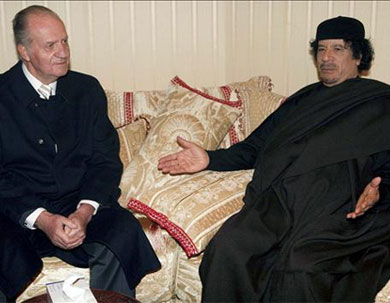
Mon album de famille, par Mouammar Kadhafiالبوم صور عائلة القذافي
Les hypocrites ! Ils disent tous que j’ ai toujours été leur ennemi. Aucun ne se souvient de m’avoir connu et fréquenté. Et pourtant…
المنافقون! يقولون انهم اعدائي. ولا احد تعامل معي. مع ان هذه الصور تثبت نفاق جميع اصدقائي الاعزاء
Charlotte Lebouvier : Gandhi homosexuel … et xénophobe ?
C’est la polémique qui enfle ces jours-ci, après la sortie du livre : "Great Soul: Mahatma Gandhi and his struggle with India" (Une grande âme: Mahatma Gandhi et sa lutte en Inde) de l’américain Joseph Lelyveld, ancien journaliste en Inde et pour le New York Times, et gagnant du prix Pulitzer de journalisme en 1986.
Le Mahatma aurait été très amoureux d’un architecte allemand nommé Hermann Kallenbach, qui selon l'Histoire, n'était pas plus qu"un ami très proche.
Dans des lettres récupérées par Lelyveld, Gandhi lui aurait écrit « comment tu as totalement pris possession de ma personne. », « tu es toujours dans mes pensées » (en 1933) et entre autre, que la vaseline lui rappelait son ami et que l’unique photo qui trônait sur sa cheminée était la sienne.
Gandhi aurait quitté sa femme pour vivre son histoire d’amour en 1908, alors en Afrique du Sud. Le couple se séparera en 1914, au début de la première guerre mondiale, Kallenbach ne pouvant quitter l’Allemagne pour rejoindre Gandhi retourné en Inde.
Enfin, le journaliste révèle dans son livre que Gandhi avait un grand contrôle de la presse et des medias et qu’il refusait que les mots sortis de sa bouche soient diffusés sans son autorisation… De quoi se retourner dans sa tombe…
Le Mahatma aurait été très amoureux d’un architecte allemand nommé Hermann Kallenbach, qui selon l'Histoire, n'était pas plus qu"un ami très proche.
Dans des lettres récupérées par Lelyveld, Gandhi lui aurait écrit « comment tu as totalement pris possession de ma personne. », « tu es toujours dans mes pensées » (en 1933) et entre autre, que la vaseline lui rappelait son ami et que l’unique photo qui trônait sur sa cheminée était la sienne.
Gandhi aurait quitté sa femme pour vivre son histoire d’amour en 1908, alors en Afrique du Sud. Le couple se séparera en 1914, au début de la première guerre mondiale, Kallenbach ne pouvant quitter l’Allemagne pour rejoindre Gandhi retourné en Inde.
Enfin, le journaliste révèle dans son livre que Gandhi avait un grand contrôle de la presse et des medias et qu’il refusait que les mots sortis de sa bouche soient diffusés sans son autorisation… De quoi se retourner dans sa tombe…
Labels:
Francais
Ce que l'on sait de l'opposition libyenne : Francois Lenoir
http://www.lexpress.fr/actualite/monde/ce-que-l-on-sait-de-l-opposition-libyenne_977111.html#xtor=AL-447
Le 5 mars, le Conseil national de transition, qui s'est déclaré "seul représentant de la Libye", a désigné Mahmoud Jibril à la tête d'une "équipe exécutive pour gérer la crise". Ali Abdelaziz al-Issaoui (à droite), ambassadeur démissionnaire de Libye en Inde et ancien ministre de l'Economie, s'est vu confier les Affaires étrangères.
Qui sont les rebelles lybiens et qui compose le Conseil national de transition qui fait office de gouvernement des insurgés. LEXPRESS.fr fait le point.
Dans la Libye de Kadhafi, à la différence de la Tunisie et de l'Egypte, il n'y avait aucune place pour les partis politiques, les syndicats, les médias indépendants et la société civile était quasiment inexistante. Ce vide politique rend difficile l'émergence de futurs dirigeants au sein de l'opposition.
Le Conseil national de transition (CNT), composé de 31 représentants des principales villes libyennes, sert de gouvernement de fait à l'opposition libyenne depuis le début du soulèment. La création d'un "Conseil national indépendant" de transition basé à Benghazi, représentant les villes tombées aux mains de l'insurrection, a été annoncée le 27 février. Le nom de certains des représentants d'Ajdabiya, Al Kufrah, Ghat, Nalut, Misrata, Zentan and Zawiya n'a pas été révélé pour des raisons de sécurité. Pour le moment, il n'y a pas de représentant pour le centre et le sud de la Libye ni pour Tripoli. Selon Ali Zeidan, chargé de mission du CNT, de passage à Paris, le 22 mars, ses membres "sont principalement des avocats, des professeurs, des universitaires".
Le 5 mars, le Conseil national de transition, qui s'est déclaré "seul représentant de la Libye", a désigné Mahmoud Jibril à la tête d'une "équipe exécutive pour gérer la crise". Ali Abdelaziz al-Issaoui (à droite), ambassadeur démissionnaire de Libye en Inde et ancien ministre de l'Economie, s'est vu confier les Affaires étrangères.
Qui sont les rebelles lybiens et qui compose le Conseil national de transition qui fait office de gouvernement des insurgés. LEXPRESS.fr fait le point.
Dans la Libye de Kadhafi, à la différence de la Tunisie et de l'Egypte, il n'y avait aucune place pour les partis politiques, les syndicats, les médias indépendants et la société civile était quasiment inexistante. Ce vide politique rend difficile l'émergence de futurs dirigeants au sein de l'opposition.
Le Conseil national de transition (CNT), composé de 31 représentants des principales villes libyennes, sert de gouvernement de fait à l'opposition libyenne depuis le début du soulèment. La création d'un "Conseil national indépendant" de transition basé à Benghazi, représentant les villes tombées aux mains de l'insurrection, a été annoncée le 27 février. Le nom de certains des représentants d'Ajdabiya, Al Kufrah, Ghat, Nalut, Misrata, Zentan and Zawiya n'a pas été révélé pour des raisons de sécurité. Pour le moment, il n'y a pas de représentant pour le centre et le sud de la Libye ni pour Tripoli. Selon Ali Zeidan, chargé de mission du CNT, de passage à Paris, le 22 mars, ses membres "sont principalement des avocats, des professeurs, des universitaires".
Labels:
Francais
Subscribe to:
Posts (Atom)